Equipment Health Monitoring for Chillers & HVAC Systems
Engineering-based health monitoring for chillers, HVAC systems and cooling infrastructure that detects performance degradation before it becomes an energy, reliability or maintenance problem.
Every engineering parameter tells a story.
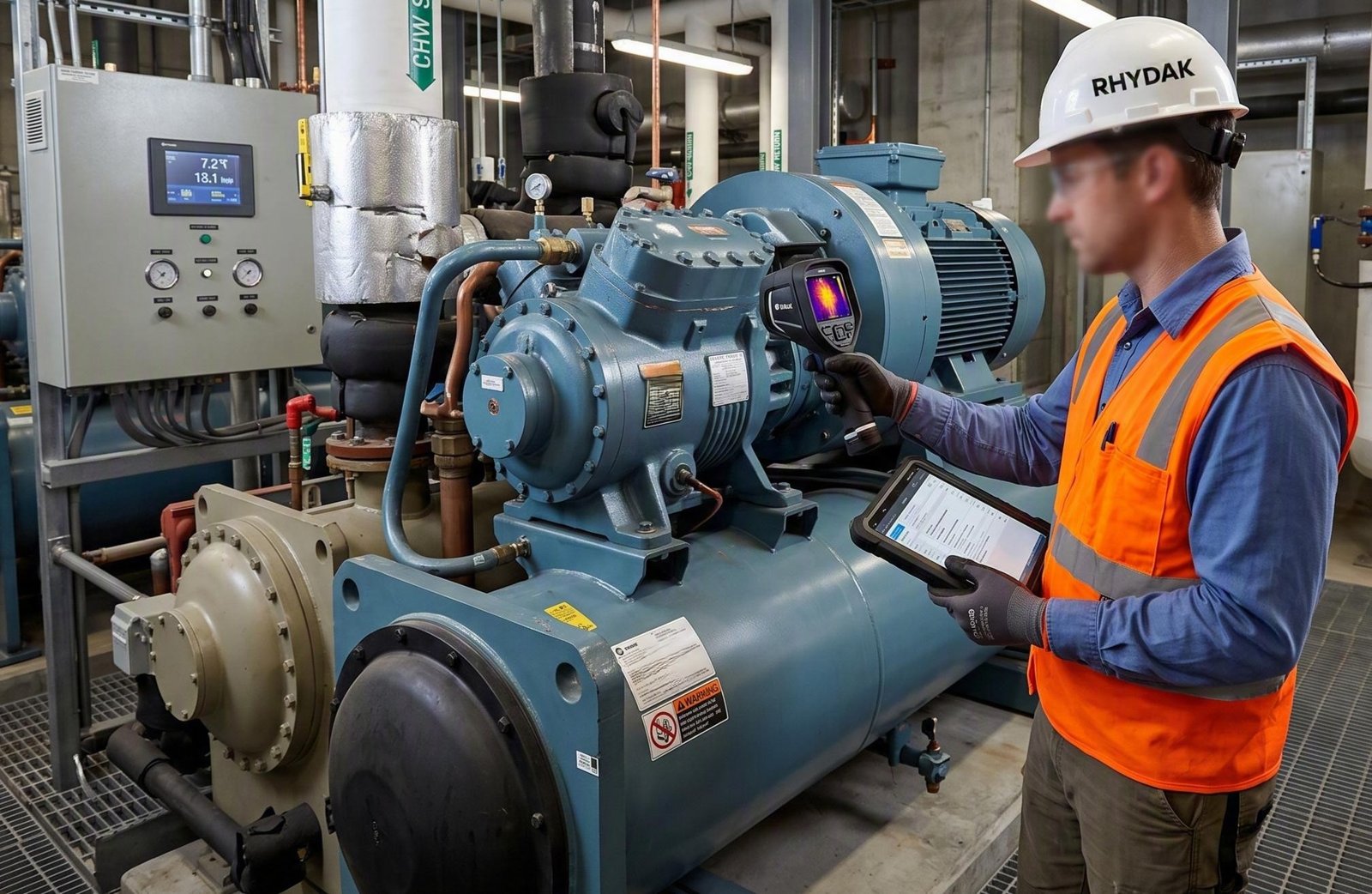
RHYDAK correlates refrigeration cycle, hydraulic performance, compressor loading, heat transfer and control behaviour to identify equipment degradation before performance, reliability or energy consumption are affected.
Heat Transfer Performance
- • Evaporator Approach
- • Condenser Approach
- • Discharge Superheat
- • Liquid Subcooling
- • Saturation Temperatures
- • Heat Exchanger Fouling Trend
Compressor Reliability
- • Compressor Lift
- • Motor Current
- • Oil Differential Pressure
- • Oil Temperature
- • Bearing Temperature
- • Operating Envelope
Evidence-Based Diagnosis
- • Root Cause Identification
- • Progressive Degradation Trend
- • Reliability Assessment
- • Condition-Based Maintenance
- • Remaining Performance Margin
- • Engineering Recommendation
One abnormal value does not indicate a fault.
A high condensing temperature, low COP or elevated motor current does not independently identify the problem. RHYDAK correlates dozens of thermodynamic, hydraulic, electrical and control relationships simultaneously before identifying the engineering root cause.
Collect Multi-System Evidence
Temperatures, pressures, flow, power, compressor loading, VFD behaviour, control response and historical trends.
Reject False Causes
Different faults often produce similar symptoms. RHYDAK eliminates unlikely causes using engineering relationships before identifying the actual degradation mechanism.
Identify Root Cause
Instead of reporting alarms, RHYDAK explains why performance changed, what component is responsible, and what engineering action should be taken.
High Condensing Pressure Investigation
Condenser fouling is the most probable cause.
Cooling tower degradation is unlikely because condenser water ΔT remains within the expected operating range.
Engineering inspection should first focus on condenser tube cleanliness before investigating refrigerant charge or compressor condition.
Knowing the fault is only the beginning.
Engineering intelligence should lead to the correct maintenance strategy. RHYDAK prioritises actions based on equipment condition, performance impact, reliability risk and operating criticality.
Healthy
Equipment operating within engineering limits. Continue monitoring and performance trending.
Monitor
Progressive degradation detected. Schedule engineering inspection during planned maintenance.
Plan Intervention
Performance deterioration is affecting plant efficiency. Corrective action should be prioritised during the next shutdown.
Immediate Action
High reliability risk or severe thermodynamic deviation. Immediate engineering intervention recommended.
Engineering intelligence across the complete cooling infrastructure.
Equipment health cannot be assessed by evaluating chillers alone. RHYDAK correlates the operating behaviour of every major component influencing cooling plant performance.
Chiller Package
- • Screw Compressors
- • Centrifugal Compressors
- • Scroll Compressors
- • Evaporators
- • Condensers
- • Refrigerant Circuit
Balance of Plant
- • Chilled Water Pumps
- • Condenser Water Pumps
- • Cooling Towers
- • Plate Heat Exchangers
- • Variable Frequency Drives
- • Control Valves
Control & Electrical
- • PLC & BMS Integration
- • Control Sequences
- • Sensors & Instrumentation
- • Electrical Loading
- • Motor Performance
- • Plant Trending
Critical parameters that define equipment health.
RHYDAK evaluates engineering parameters that directly influence chiller efficiency, HVAC reliability, refrigeration performance and cooling infrastructure health. These parameters are analysed together to identify degradation trends and engineering root causes.
Refrigeration Cycle
- • Suction Superheat
- • Discharge Superheat
- • Liquid Subcooling
- • Evaporating Temperature
- • Condensing Temperature
- • Compression Ratio
Water Side
- • CHW Supply Temperature
- • CHW Return Temperature
- • Condenser Water Temperature
- • Evaporator ΔT
- • Condenser ΔT
- • Water Flow Rate
Compressor
- • Motor Current
- • Oil Temperature
- • Oil Differential Pressure
- • Compressor Lift
- • Runtime Hours
- • Operating Envelope
Plant Performance
- • COP
- • Plant kW/TR
- • IPLV
- • NPLV
- • Cooling Capacity
- • Equipment Health Index
Built for mission-critical cooling infrastructure.
RHYDAK equipment health monitoring is designed for facilities where cooling performance, equipment reliability and energy efficiency directly influence operational continuity.
Data Centres
Continuous monitoring of mission-critical chillers, pumps, cooling towers and refrigeration systems supporting high-availability data centre cooling.
Commercial HVAC
Office buildings, hospitals, airports, hotels and institutional facilities operating central chilled water systems.
Industrial Cooling
Process cooling applications where equipment health directly affects production stability and product quality.
Pharmaceutical & Healthcare
Reliable cooling infrastructure supporting controlled environments, laboratories and manufacturing processes.
Manufacturing
Engineering health assessment for process chillers, utility systems and high-capacity industrial refrigeration equipment.
Cooling Infrastructure
Integrated engineering intelligence across chillers, pumps, cooling towers, heat exchangers, controls and complete chilled water plants.
From plant data to engineering decisions.
Every equipment health assessment follows a structured engineering methodology that transforms operating data into actionable recommendations.
Collect
Operating data, trends and plant configuration
Validate
Sensor quality and engineering consistency
Correlate
Thermodynamic and hydraulic relationships
Diagnose
Root cause of performance degradation
Recommend
Maintenance and optimisation priorities
Verify
Measure improvement after implementation
Move beyond equipment monitoring.
RHYDAK combines HVAC engineering expertise, thermodynamic analysis and equipment health monitoring to detect degradation, improve reliability and support engineering decisions across chillers and cooling infrastructure.